
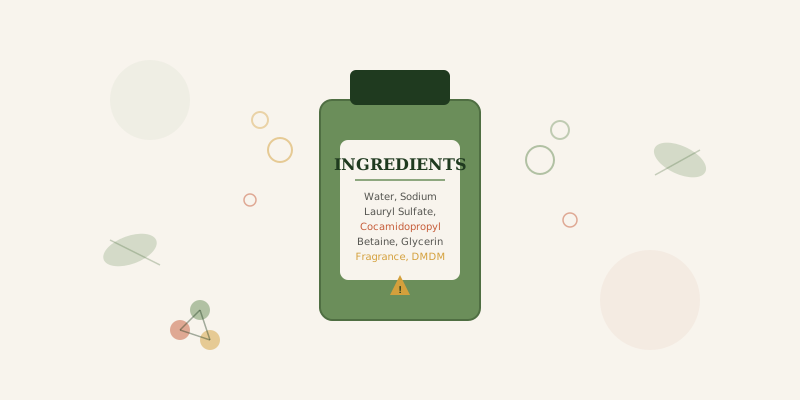
"Sulfate-free" has become one of the most prominent claims in the hair care aisle. But what are sulfates, exactly? Are they as dangerous as some marketing suggests? And does everyone really need to avoid them?
The short answer: sulfates are effective cleansing agents that are safe for most people, but not ideal for everyone. The longer answer requires understanding what sulfates do, how they work, and when they may cause problems. Let's dig into the science.
What Are Sulfates?
Sulfates are a class of surfactants — compounds that lower the surface tension of liquids, allowing them to spread and penetrate more easily. In hair care, surfactants are the ingredients that make shampoo "lather" and lift oil, dirt, and product buildup from the hair and scalp.
The most common sulfates in hair care are:
- Sodium Lauryl Sulfate (SLS): The strongest and most deeply cleansing sulfate. It produces rich lather and is highly effective at removing oil.
- Sodium Laureth Sulfate (SLES): A milder cousin of SLS. It's slightly less aggressive but still produces good lather and is the most common sulfate in commercial shampoos.
- Ammonium Lauryl Sulfate (ALS): Similar to SLS but with a different counter-ion. Used in some clarifying shampoos.
How Sulfates Work
Sulfate molecules have a hydrophilic (water-loving) head and a lipophilic (oil-loving) tail. When you massage shampoo into wet hair, the lipophilic tails attach to oil and sebum on your hair and scalp, while the hydrophilic heads face outward toward the water. When you rinse, the water carries the surfactant — and the oil attached to it — away.
This is effective cleansing. But sulfates, particularly SLS, are anionic surfactants, meaning they carry a negative charge. They're also relatively small molecules that can penetrate the hair shaft. This combination means they don't just remove oil — they can also strip some of the hair's natural moisture and, in some cases, cause irritation.
Are Sulfates Dangerous?
The simple answer is no — sulfates are not dangerous in the concentrations used in cosmetics. Regulatory bodies including the FDA, the European Commission, and Health Canada have reviewed the safety of SLS and SLES and concluded they are safe for use in rinse-off products at typical concentrations (usually 1-30% in shampoos).
The "sulfates are toxic" narrative is largely a marketing-driven oversimplification. However, "not dangerous" is not the same as "ideal for everyone." There are legitimate reasons some people prefer to avoid sulfates.
Who Should Consider Avoiding Sulfates?
1. People with Curly or Coily Hair
Curly and coily hair types (Types 3 and 4) are naturally drier because sebum has difficulty traveling down the curved hair shaft. Sulfates can strip what little oil remains, leading to dryness, frizz, and breakage. The Curly Girl Method explicitly recommends avoiding sulfates for this reason.
2. People with Color-Treated Hair
Sulfates can accelerate color fading. The strong cleansing action lifts dye molecules from the hair shaft. If you color your hair, sulfate-free shampoos help preserve color longevity.
3. People with Dry or Sensitive Scalps
SLS is a known skin irritant at higher concentrations. While the amount in shampoo is generally well-tolerated, people with eczema, psoriasis, or sensitive skin may find sulfates exacerbate itching, flaking, or redness.
4. People with Chemically Treated Hair
Relaxers, perms, and keratin treatments alter the hair's structure, making it more porous and vulnerable. Sulfates can be too harsh for hair that's already been stressed by chemical processing.
Who Can Use Sulfates Without Issue?
For many people, sulfates are perfectly fine — and even preferable. If you have:
- Oily hair: Sulfates effectively remove excess sebum that can make hair look greasy.
- Straight, healthy hair: The natural oils in straight hair travel easily, and the hair is resilient enough to handle sulfate cleansing.
- Heavy product buildup: Sulfates are excellent at removing silicone buildup, heavy styling products, and hard water minerals.
- No scalp sensitivity: If your scalp doesn't react to sulfates, there's no health reason to avoid them.
"The question isn't whether sulfates are 'good' or 'bad' — it's whether they're the right tool for your specific hair and scalp needs."
Sulfate-Free Alternatives
If you decide to go sulfate-free, you'll encounter alternative surfactants. These are gentler but produce less lather — which can take getting used to if you associate lather with cleanliness.
Common sulfate-free surfactants include:
- Cocamidopropyl Betaine (CAPB): A coconut-derived amphoteric surfactant that's gentle and produces moderate lather.
- Decyl Glucoside: A very mild plant-derived cleanser suitable for sensitive scalps.
- Sodium Cocoyl Isethionate: A gentle coconut-derived surfactant that produces creamy lather.
- Sodium Lauroyl Sarcosinate: A milder anionic surfactant that cleanses without the harshness of SLS.
Note: Some "sulfate-free" products still use effective cleansers — they're not necessarily less effective, just less stripping.
The Clarifying Shampoo Exception
Even if you use sulfate-free shampoo daily, a clarifying shampoo with sulfates can be useful occasionally — every 2-4 weeks — to remove stubborn buildup from silicones, hard water, or heavy styling products. If your hair starts to look dull, feel coated, or resist absorption of products, it may be time to clarify.
How to Choose
The decision to use or avoid sulfates should be based on your hair type, scalp condition, and personal preference — not fear. Here's a simple framework:
- Assess your hair type: Curly, coily, color-treated, or chemically processed? Lean sulfate-free.
- Check your scalp: Itchy, dry, or sensitive? Sulfate-free is likely better.
- Consider your routine: Use heavy products or live in a hard water area? A sulfate clarifying shampoo once a month may help.
- Listen to your hair: If your hair feels dry, stripped, or frizzy after washing, your shampoo may be too harsh.
The Bottom Line
Sulfates are effective, safe, and affordable cleansing agents that work well for many people. They're not toxic, carcinogenic, or inherently harmful. But they can be too harsh for certain hair types and scalp conditions.
The best approach is informed and individualized. Know your hair type, observe how it responds to products, and adjust accordingly. Don't avoid sulfates out of fear — but don't use them blindly either. The most effective hair care routine is one tailored to your hair's actual needs.

Related reading: Silicone in Hair Products · Reading Ingredient Labels · Ingredient Database