
Hair product labels can look like a foreign language. "Cocamidopropyl betaine," "behentrimonium methosulfate," "phenoxyethanol" — these names are intimidating. But once you understand a few basic principles, reading an ingredient list becomes straightforward, even empowering.
This guide will teach you how to decode any hair product label: the rules of ingredient ordering, how to recognize ingredient families, and which ingredients deserve a second look.
Rule 1: Ingredients Are Listed in Descending Order of Concentration
This is the single most important rule. By law in most countries (including the US, EU, and Canada), cosmetic ingredients must be listed in descending order of concentration. The ingredient present in the highest amount goes first; the lowest goes last.
This means the first 5-7 ingredients typically make up 80-90% of the product. If a product's first five ingredients are water, sodium lauryl sulfate, sodium chloride, fragrance, and cocamidopropyl betaine, you know it's primarily a strong cleanser with fragrance — regardless of what the front of the bottle claims.
The marketing trick to watch for: Products often highlight a "star" ingredient (like argan oil or keratin) on the front. Check where it appears on the ingredient list. If "argania spinosa kernel oil" is the 25th ingredient, there's very little of it in the product. This is called "fairy dusting" — including a tiny amount of a desirable ingredient purely for marketing.
Rule 2: The 1% Line
Ingredients present at concentrations below 1% can be listed in any order. This means the last few ingredients on the list aren't necessarily the least abundant — they're just all below 1%.
Preservatives, fragrances, and active ingredients (like panthenol or certain extracts) are typically used at less than 1% and often appear near the end of the list. A useful guideline: the ingredients after "phenoxyethanol" (a common preservative used at 0.5-1%) are likely all below 1%.
Rule 3: INCI Names Are Standardized
Ingredients are listed by their INCI (International Nomenclature of Cosmetic Ingredients) name, a standardized system used globally. Learning to recognize common INCI names is like learning a vocabulary — it gets easier with practice.
Common Ingredients and Their INCI Names
- Water: Aqua (always first in water-based products)
- Glycerin: Glycerin
- Coconut oil: Cocos Nucifera Oil
- Argan oil: Argania Spinosa Kernel Oil
- Shea butter: Butyrospermum Parkii Butter
- Jojoba oil: Simmondsia Chinensis Seed Oil
- Vitamin E: Tocopherol
- Pro-Vitamin B5: Panthenol
- Aloe vera: Aloe Barbadensis Leaf Juice
"The front of the bottle is marketing. The back of the bottle is truth. Always turn the bottle around."
Recognizing Ingredient Families
Sulfates (Surfactants)
Look for "sulfate" or "sulfonate" in the name. Common examples: Sodium Lauryl Sulfate, Sodium Laureth Sulfate, Ammonium Lauryl Sulfate. These are strong cleansers — fine for some, too harsh for others.
Silicones
Look for "-cone," "-conol," or "-xane" in the name. Common examples: Dimethicone, Amodimethicone, Cyclomethicone. Silicones coat the hair for smoothness and shine. Water-soluble silicones include "PEG-" prefix.
Alcohols
Not all alcohols are drying. The ones to avoid are short-chain alcohols: Isopropyl Alcohol, Ethanol, SD Alcohol, Denatured Alcohol. These strip moisture. Fatty alcohols (Cetearyl Alcohol, Cetyl Alcohol, Stearyl Alcohol, Behenyl Alcohol) are emollients that condition and soften — they're beneficial.
Proteins
Look for "hydrolyzed" followed by a protein source: Hydrolyzed Keratin, Hydrolyzed Silk, Hydrolyzed Wheat Protein, Hydrolyzed Collagen. These temporarily fill gaps in the hair shaft. Beneficial for damaged hair; can cause brittleness if overused.
Preservatives
Every water-containing product needs preservatives to prevent microbial growth. Common preservatives include Phenoxyethanol, Sodium Benzoate, Potassium Sorbate. Some controversial preservatives to be aware of: DMDM Hydantoin, Quaternium-15, Methylparaben, Propylparaben.
Red-Flag Ingredients
These ingredients aren't necessarily dangerous, but they're worth being aware of — especially if you have a sensitive scalp or specific preferences:
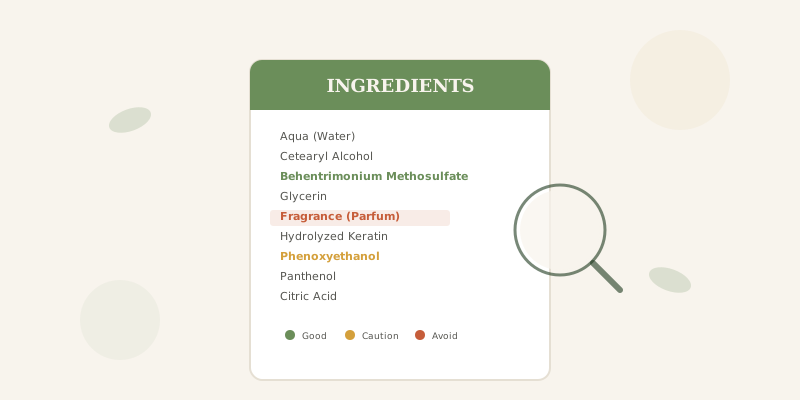
- Fragrance (Parfum): A trade-secret blend that can contain dozens of components. The #1 cause of contact dermatitis in cosmetics. If you have sensitive skin, look for "fragrance-free."
- Formaldehyde releasers: DMDM Hydantoin, Quaternium-15, Diazolidinyl Urea, Imidazolidinyl Urea. These slowly release trace amounts of formaldehyde as a preservative. Known sensitizers.
- Isopropyl alcohol: A drying solvent that strips moisture. Common in cheaper styling products.
- Parabens: Methylparaben, Propylparaben, Butylparaben. Effective preservatives, but controversial due to potential endocrine activity.
Green-Flag Ingredients
Ingredients that are broadly beneficial for most hair types:
- Glycerin: Effective humectant at reasonable concentrations
- Panthenol: Conditions and improves moisture retention
- Cetearyl Alcohol: Fatty alcohol that softens and thickens
- Behentrimonium Methosulfate: Gentle, effective detangler
- Decyl Glucoside: Very gentle plant-based cleanser
- Natural oils and butters: When listed in the top 10 ingredients
Putting It All Together: A Sample Label Walkthrough
Let's analyze a hypothetical conditioner label:
Aqua, Cetearyl Alcohol, Behentrimonium Methosulfate, Glycerin, Argania Spinosa Kernel Oil, Panthenol, Hydrolyzed Keratin, Aloe Barbadensis Leaf Juice, Sodium Benzoate, Potassium Sorbate, Fragrance, Phenoxyethanol.
Here's how to read it:
- Water (Aqua): The base. Expected.
- Cetearyl Alcohol: A fatty alcohol — good. It's the primary conditioner.
- Behentrimonium Methosulfate: A gentle detangling agent. Good sign.
- Glycerin: Humectant for moisture. Good.
- Argan Oil: Listed 5th — there's a meaningful amount. Not just fairy dusting.
- Panthenol: Conditioning pro-vitamin.
- Hydrolyzed Keratin: Protein. Good for damaged hair; monitor for overuse.
- Aloe Vera: Soothing and hydrating.
- Preservatives: Sodium Benzoate and Potassium Sorbate — gentle, food-grade preservatives.
- Fragrance: Present, but near the end (likely below 1%). Acceptable for most.
- Phenoxyethanol: Standard preservative. Everything after this is below ~1%.
Verdict: This is a well-formulated conditioner with meaningful amounts of beneficial ingredients, gentle preservatives, and no red-flag additives. The argan oil is present at a real concentration. The protein is present but not dominant. A solid choice for most hair types.
Common Label Claims Decoded
- "Natural": No legal definition. Can mean almost anything. Read the ingredient list.
- "Organic": Unless certified (USDA Organic, COSMOS, Ecocert), this is marketing.
- "Sulfate-free": No SLS, SLES, or ALS. Check for alternative surfactants.
- "Silicone-free": No ingredients ending in -cone, -conol, or -xane.
- "Paraben-free": No methylparaben, propylparaben, etc. Check for alternative preservatives.
- "For color-treated hair": Usually means gentle surfactants and pH-balanced — but not always. Read the label.
Practical Tips
- Don't memorize everything. Learn the 10-15 most common ingredients. That covers most products.
- Use reference tools. Our ingredient database covers the most common ingredients with ratings.
- Focus on the first 10 ingredients. They make up the bulk of the product. The last 10 ingredients rarely matter.
- Compare similar products. Reading two conditioners side by side is the fastest way to learn.
- Trust your hair. If a product works, the label matters less. If it doesn't, the label tells you why.
The Bottom Line
Reading ingredient labels is a skill — and like any skill, it improves with practice. The principles are simple: ingredients are listed by concentration, INCI names are standardized, and certain ingredient families have predictable effects. Once you internalize these basics, you can evaluate any product in under a minute.
The front of the bottle exists to sell you something. The back of the bottle tells you what you're actually buying. Turn the bottle around, learn to read the back, and you'll never be fooled by marketing claims again.

Related reading: Full Ingredient Database · The Truth About Sulfates · Silicone in Hair Products