
The Curly Girl Method (CGM) has transformed how millions of people care for curly and coily hair. Originally popularized by Lorraine Massey's 2001 book "Curly Girl: The Handbook," the method advocates a gentle, moisture-focused approach that rejects many conventional hair care practices.
But is it right for everyone with curly hair? As with most things in hair care, the answer is nuanced. Let's examine the method's principles, the science behind them, and how to decide if it suits your hair.
The Core Principles of the Curly Girl Method
The CGM is built on several key rules. Here's what the method asks you to do — and not do:
1. No Sulfates
The method prohibits shampoos containing sodium lauryl sulfate, sodium laureth sulfate, and other sulfates. The reasoning: sulfates strip natural oils, which curly hair already struggles to retain due to the curved hair shaft.
The science: This is sound. Curly and coily hair is naturally drier because sebum can't travel down the curved shaft as easily. Sulfates, especially SLS, are aggressive cleansers that remove what little oil remains. Sulfate-free cleansers are gentler alternatives.
2. No Silicones (in most formulations)
The CGM prohibits non-water-soluble silicones (dimethicone, etc.) because they require sulfates to remove, creating a cycle: silicones to smooth, sulfates to remove them, sulfates dry the hair, more silicones to smooth. Breaking this cycle is central to the method.
The science: This logic is valid. Non-water-soluble silicones do require surfactants to remove, and without sulfates, they build up. However, water-soluble silicones (PEG-dimethicone) are compatible with the method and offer benefits without buildup. The blanket ban on all silicones is stricter than necessary.
3. No Heat Styling
The method discourages flat irons, curling wands, and blow dryers without diffusers. Heat damages the hair's protein structure, which is particularly detrimental to curly hair's already fragile curl pattern.
The science: Heat damage is real. Temperatures above 180°C (356°F) can denature keratin proteins in the hair, permanently altering curl pattern. Air-drying or diffusing on low heat preserves curl integrity. This principle is well-supported.
4. Co-Washing or Low-Poo Cleansing
Instead of traditional shampoo, the CGM advocates "co-washing" (using conditioner to cleanse) or "low-poo" (using sulfate-free shampoo). The idea is that conditioner contains enough mild surfactants to clean without stripping.
The science: Co-washing works for many curl types, particularly Types 3 and 4. Conditioners contain cationic surfactants (like behentrimonium chloride) that have some cleansing ability. However, co-washing alone may not remove heavy buildup, sebum, or silicones. Periodic clarification is still needed.
"The Curly Girl Method isn't a religion — it's a framework. The best version is one adapted to your specific hair, not followed dogmatically."
5. The "Squish to Condish" Method
This technique involves applying conditioner to wet hair, adding more water, and "squishing" the hair in upward motions to encourage curl formation and moisture absorption.
The science: This technique works by encouraging water absorption into the hair shaft (hydration) and encouraging the hair's natural curl pattern to clump together. The physical motion helps distribute product evenly and encourages curl definition. It's an effective technique supported by the mechanics of how curly hair behaves when hydrated.
6. No Terrycloth Towels
The CGM recommends using a microfiber towel or cotton t-shirt to dry hair instead of terrycloth towels, which cause friction and frizz.
The science: Terrycloth's rough texture roughs up the cuticle, causing frizz — especially noticeable on curly hair where the pattern makes frizz more visible. Smooth fabrics reduce friction. This is a small change with real benefits.
Who Benefits Most from the CGM?
The method works best for:
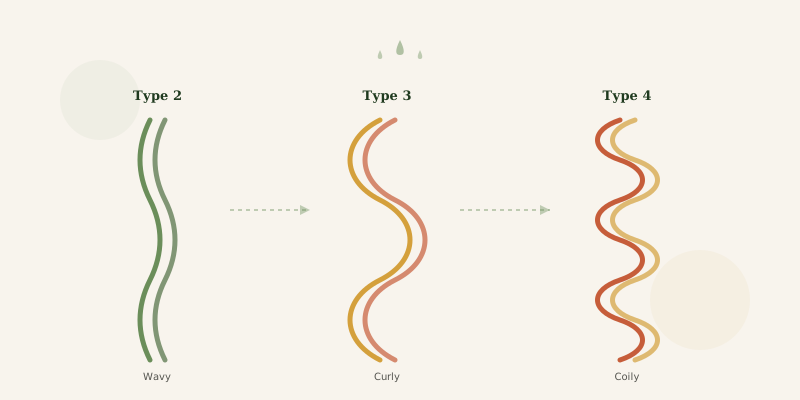
- Type 3 (curly) and Type 4 (coily) hair: These hair types benefit most from moisture retention and gentle handling.
- Dry, damaged, or high-porosity hair: The moisture-focused approach helps restore hydration.
- People with frizz issues: Eliminating sulfates and silicones often reduces frizz dramatically.
- Those new to embracing natural texture: The structured approach provides a clear starting point.
When the CGM Might Not Work
The method isn't universally ideal. It may not suit:
- Fine or low-porosity curly hair: Co-washing and heavy conditioners can weigh this hair down, causing "greasy" roots and flat curls.
- Oily scalps: Co-washing may not adequately remove sebum, leading to buildup and scalp issues.
- People who use styling products heavily: Gels, mousses, and creams can build up without periodic shampooing.
- Hard water areas: Mineral buildup requires chelating shampoo, which the CGM doesn't account for.
The Transition Period
If you switch to the CGM, expect a transition period of 2-6 weeks. During this time:
- Your hair may feel greasy as your scalp adjusts to reduced cleansing
- Curls may look inconsistent as old damage grows out
- You may experience a "detox" period as silicone buildup is finally removed
- Scalp condition may temporarily worsen before improving
Patience is essential. Many people abandon the method during transition, never reaching the point where their hair adapts. Give it at least 6 weeks before evaluating.
Modified Approaches
The most successful curly hair routines often borrow from the CGM without following it rigidly. Consider these modifications:
The Low-Poo Approach
Instead of co-washing exclusively, use a gentle sulfate-free shampoo 1-2 times per week. This removes buildup while remaining gentle. Many people find this more practical than pure co-washing.
Periodic Clarification
Even within the CGM framework, a clarifying treatment every 4-6 weeks can reset the hair and scalp. Use a sulfate shampoo or a clay mask, then deep condition immediately after.
Strategic Silicone Use
Water-soluble silicones can provide heat protection and frizz control without violating the spirit of the method. They rinse out with water, so no sulfates are needed to remove them.
Protein-Moisture Balance
The CGM is heavily moisture-focused, but curly hair also needs protein — especially if it's damaged or color-treated. Incorporate a protein treatment monthly to maintain the protein-moisture balance.
A Sample CGM-Inspired Routine
- Cleanse (1-2x weekly): Sulfate-free shampoo or co-wash, focusing on scalp
- Condition: Apply rich conditioner, detangle with fingers or wide-tooth comb, use "squish to condish" technique
- Leave-in: Apply leave-in conditioner to soaking wet hair
- Style: Apply curl cream or gel using "praying hands" or raking method, then scrunch upward
- Dry: Air dry or diffuse on low. Don't touch until fully dry.
- Refresh (between wash days): Spritz with water and a little leave-in, scrunch to reactivate product
The Science of Curl Formation
Understanding why the CGM works requires understanding how curls form. Curl pattern is determined by the shape of the hair follicle — round follicles produce straight hair; oval follicles produce wavy hair; flat, asymmetrical follicles produce curly and coily hair.
The asymmetrical follicle causes the hair shaft to grow at an angle, creating an oval cross-section. This oval shape means the hair has different amounts of cuticle on each side — more cuticle on the outside of the curve, fewer on the inside. This asymmetry makes curly hair more vulnerable to damage and dryness on the outer curve.
The CGM's moisture focus addresses this vulnerability directly. By keeping curly hair well-hydrated and minimizing cuticle disruption (no sulfates, no rough towels, no heat), the method helps maintain the hair's natural curl pattern and reduce breakage.
Making the Decision
Should you try the Curly Girl Method? Consider these questions:
- Is your hair Type 3 or Type 4? The method is designed for these textures.
- Is your hair dry or frizz-prone? The moisture focus addresses both.
- Can you commit to 6 weeks of transition? Results take time.
- Are you willing to avoid sulfates, silicones, and heat? These are non-negotiable in the strict method.
- Do you have a fine or oily scalp? You may need modifications.
The CGM is an excellent starting point for anyone with curly or coily hair who hasn't explored texture-focused care. But it's a framework, not a rulebook. The best approach takes the method's sound principles — moisture retention, gentle handling, minimizing damage — and adapts them to your individual hair type, scalp condition, and lifestyle.
Final Thoughts
The Curly Girl Method has helped millions of people embrace and enhance their natural curl pattern. Its emphasis on moisture, gentle cleansing, and damage prevention is well-supported by the science of curly hair. However, its rigid rules — particularly the complete ban on silicones and the advocacy of co-washing for everyone — may not suit every curl type.
Take what works, modify what doesn't, and always listen to your hair. The goal isn't to follow a method perfectly; it's to find the routine that helps your curls look and feel their best.

Related reading: Understanding Your Hair Type · The Truth About Sulfates · Minimalist Routine